

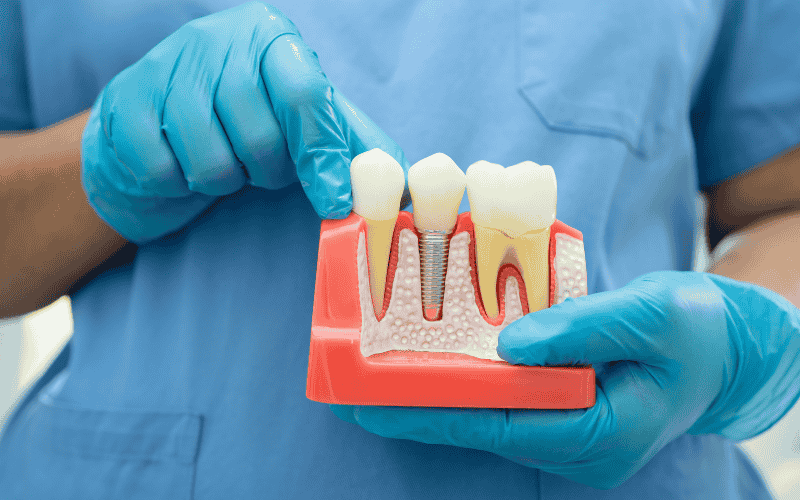

Dental implants are small titanium posts that replace missing tooth roots. A dentist places the post in your jaw, and a custom crown attaches on top. Since the post fuses with bone over a few months, the implant stays firmly in place. Here are some of the long-term effects you may notice after treatment:
Restored Bite
Missing teeth change how you chew. Dental implants support a crown, so your bite feels closer to a natural tooth. Many people who once avoided tough foods report wider menu choices after the bone fully heals around the post.
Chewing power depends on a stable foundation. The fused post gives your crown that base, and the result holds up under daily use. When you eat with strong teeth, your diet often grows more varied.
Prevented Bone Loss
Your jawbone needs stimulation to stay dense. When a tooth root disappears, the bone beneath it slowly shrinks. An implant post acts like a root, and that pressure signals the bone to maintain itself.
Tooth loss starts a quiet chain of changes. Since the implant transfers chewing force into the jaw, the surrounding bone keeps its structure over time. Patients who replace teeth early typically preserve more of their natural facial shape.
You may notice a few practical effects of preserved bone:
- A steadier fit for nearby restorations
- A more even pressure across your jaw
- A fuller appearance along the jawline
Protected Adjacent Teeth
A gap rarely stays empty for long. Neighboring teeth tend to drift toward the open space, and that movement throws off your alignment. An implant fills the gap, so the teeth beside it stay put.
Some tooth-replacement options grind down healthy teeth for support. An implant stands alone, and it leaves the teeth next to it untouched. This independence keeps more of your natural structure intact.
Crooked shifting also makes cleaning harder. When teeth stay aligned, you reach plaque more easily during brushing. A stable bite supports the long-term health of the whole row.
Clarified Speech
Certain sounds rely on teeth and tongue working together, and lost teeth complicate things. To fix this, an implant restores the surface your tongue presses against during speech. Implants may help:
- Improve pronunciation: Dental implants provide a stable surface for the tongue to press against, aiding in the clear articulation of sounds like “s” and “th.”
- Prevent slipping: Unlike dentures, implants are fixed in place, ensuring they don’t shift or move while you talk.
- Restore natural speech patterns: By filling gaps and supporting the jaw, implants help you regain natural speech without hesitation.
Loose dentures sometimes slip while you talk. A fixed implant holds steady, so you speak without adjusting your mouth mid-sentence. Many patients experience clearer pronunciation once they adapt to the new tooth.
Get Dental Implants Near You
Implants are a long-term option that supports your bite, bone, and nearby teeth. The process takes several months, and your dentist guides you through each stage. A thorough exam shows whether your jaw has enough bone for the procedure. Bring your questions to a consultation, and let dental providers walk you through your options. Book your appointment today to learn whether dental implants fit your needs.
